Communist rule in Czechoslovakia
The Glass RoomCommunist rule in Czechoslovakia is presented through the changing fate of the Landauer House and the competing claims made upon it: a modernist family home becomes a children’s physiotherapy gymnasium and, later, an object of heritage debate. The regime’s authority appears not only in Party membership and regulations but also in the power to assign buildings a public purpose, while private memories and legal arguments challenge the state’s account of ownership and history.
Rules, Daily Life, and Party Authority
Under the socialist order, regulations reach into ordinary life. Tomáš regards the rules governing even small matters, such as smoking indoors, as attempts to control the future. His counter-idea is an eternal present in which regulations would lose their force. Zdenka answers that this attitude may get him into trouble, making their disagreement about time also a disagreement about how safely one can live under official authority.
Party affiliation has practical value as well as ideological meaning. When a professor proposes Zdenka as a delegate to a conference in Paris, he notes that her Party membership may help her obtain an exit permit. Tomáš has made the proposal possible but does not tell her, leaving her to believe that the opportunity arose by chance. The episode shows state permission governing travel, even as Tomáš privately arranges a way through the system.
The Party’s understanding of history also becomes a point of personal dispute. When Eve suggests that Tomáš should join, he says that he cannot because the Party believes in history. Their argument turns on what that history means: Eve sees an official, imagined account shaped by forgetting, while Tomáš insists that the Party treats history as a scientific process governed by dialectical materialism. Their disagreement is not merely abstract. Tomáš’s conflict with Zdenka over his preference for the eternal present remains central to their separation.
The House Reassigned
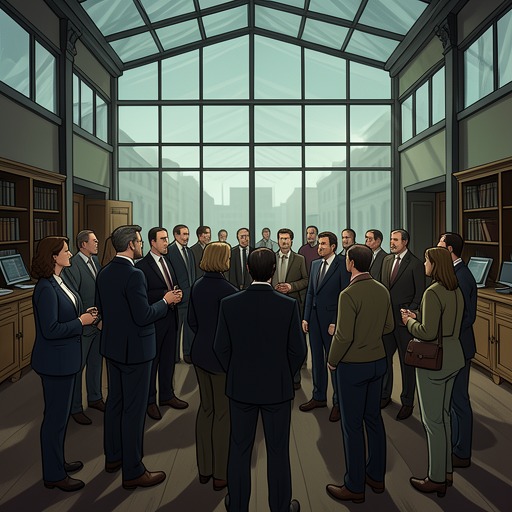
The Landauer House’s changing uses make political authority visible in its rooms. Built for a family of four, its living room measures 230 square metres and has two glass walls overlooking the city and Špilas. Its modernist design, associated with architect Rainer von Abt, is described as a masterpiece. After the house is taken from its owners and repurposed, those same spaces serve a new institutional arrangement: it becomes a gymnasium for children receiving physiotherapy.
The building’s earlier transformation had already demonstrated how readily architecture could be made to serve a different regime. Under Nazi occupation, the rooms were converted into offices, a laboratory, a photographic studio, and spaces for anthropometric equipment. Under communist rule, the house is used for treatment and dance classes instead. The purposes and political systems differ, but both histories make the building a working institution rather than simply a family home.
Tomáš calls the gymnasium the Glass Room. The word he uses for room can also mean peace, tranquillity, or quiet, making the name carry an idea beyond the building’s official function. For him, it is a space of light and stillness where he can be with Zdenka after work; he also watches her irregular dance classes there. The glass architecture thus accommodates lived experience that exceeds the state’s designation of the property as a medical facility.
Public Use and Historical Memory
A dispute over the house’s future turns on whether architectural heritage should outweigh its present use. An official interested in restoring the building and possibly making it a museum describes it as an important work of modern architecture. Tomáš objects that it is valuable as a gymnasium and unsuitable as a house or museum. He treats museums as memorials to a past that has ended, while the heritage advocate regards the building’s architectural history as a reason to preserve it.
That disagreement is connected to the Party’s authority over historical meaning. Tomáš argues that the Party believes in history, though he rejects its conception of it; Eve counters that official history is itself a fantasy formed through imagination and forgetting. The house becomes the material ground of the argument: one claim privileges its past as a masterpiece, another its present service to children, while neither use can erase the other’s history.
Property, Law, and Restoration
The family’s claim to the house persists despite its successive sequestration. Martin, speaking as a lawyer, calls it their house and argues that one illegal government took it before another did. He rejects applying the Beneš decrees to people who were driven into exile by the Nazi invasion, distinguishing their circumstances from those of Germans deemed Nazi sympathizers. The exchange establishes that the postwar property dispute is not resolved simply by the house’s incorporation into public use.
By 1990, after the fall of the Iron Curtain, the building has been repaired and some original furniture has been returned from the Moravian Museum, though the work is described as poor and updated bathroom fittings have been ruined. The Glass Room’s window panes are replaced with plate glass, restoring its clear, open appearance. Visitors now include groups from fraternal Soviet states and, later, tourists and architecture students interested in Rainer von Abt. The house is again treated as an architectural work, but its uses and accumulated histories remain part of what that restoration cannot undo.